


Contributed content: this article was written by a third-party contributor and does not necessarily reflect the views of Pop Card. Editorial and Advertising Policy
Two British stargazing spots have earned places among the finest locations on the continent for a holiday spent beneath the stars, according to fresh research that ranks Europe’s leading dark-sky destinations.
Whether you consult your horoscope daily and treat the stars as a guiding force, or you’re the sort to lug a telescope across open countryside in pursuit of distant constellations, the appeal of stargazing is difficult to argue with. Few experiences match it for sheer wonder or for the sense of scale it brings to an evening outdoors.
But does it justify travelling specifically to one of Europe’s celebrated dark-sky sites to witness the night sky at its finest? Avanti Travel Insurance examined 30 of the continent’s most prominent stargazing destinations to determine which offer the greatest rewards for astronomy lovers and adventurous visitors alike. Each location was assessed on light pollution levels, annual sunshine hours, altitude and the quality of facilities available to visitors.
The best stargazing locations in Europe
First place goes to Reserva Starlight La Palma in Spain, which achieved a score of 9.1 out of 10. Recognised globally as the world’s first Starlight Reserve, La Palma was also a pioneer in establishing a so-called “Sky Law”, legislation specifically designed to safeguard the purity of the night sky for astrophysical research. Exceptionally transparent skies, combined with the Roque de los Muchachos Observatory providing an outstanding viewpoint, secured La Palma its position at the summit of the rankings.
Second and third places belong to France, with the Réserve Internationale de Ciel Étoilé du Pic du Midi and the Alpes Azur Mercantour Dark Sky Reserve completing the podium.
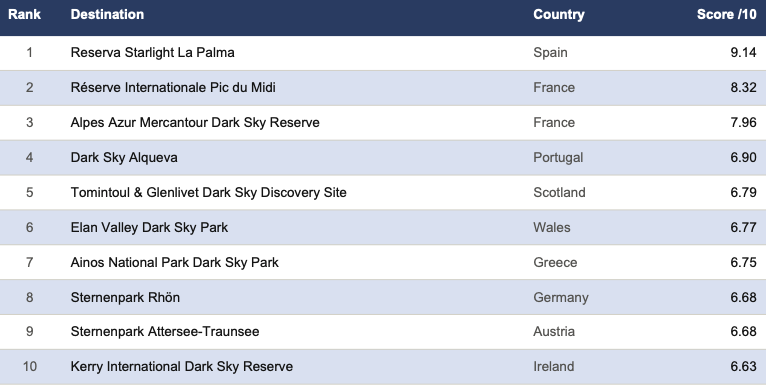
The remainder of the top ten illustrates just how diverse Europe’s stargazing offer really is. Portugal’s Dark Sky Alqueva claims fourth position, while Greece’s Ainos National Park Dark Sky Park sits in seventh place with a score of 6.75. Both Germany and Austria earn top-ten recognition, with Sternenpark Rhön and Sternenpark Attersee-Traunsee each recording 6.68. Closer to home, Tomintoul and Glenlivet Dark Sky Discovery Site in Scotland and Elan Valley in Wales both secured top-ten positions, demonstrating that British travellers need not venture abroad to find genuinely breathtaking night skies.
Across the wider continent, the variety on offer is striking. From the mountain terrain of France and the rolling countryside of Portugal to the national parks of Greece and the volcanic landscapes of Spain’s islands, the natural setting forms an integral part of the experience itself.
Further down the rankings, destinations in Switzerland, Norway, the Netherlands, Croatia, Poland and Luxembourg all appear, suggesting that almost any European itinerary could, with a little planning, incorporate a night spent under genuinely dark skies.
Stargazing also provides a fresh lens through which to discover a destination. Days can be filled with mountain walks, village exploration and local cuisine, with the focus only shifting skywards once night falls. That said, some of the lower-ranked locations serve as a reminder that spectacular skies can come at a cost. Sopotnia Wielka Dark Sky Community and Naturpark Our Dark Sky Reserve, which occupy 29th and 30th positions respectively, each scored just one out of three for visitor infrastructure, meaning travellers should be prepared for more remote conditions and limited facilities on the ground.
Why is astrotourism becoming more popular?
Unlike so many of Europe’s celebrated attractions, there are no queues to endure, no ticket booths to negotiate and no opening hours to work around. The spectacle simply reveals itself once darkness descends.
Avanti’s travel expert Sarah Rodrigues says: “Astrotourism is becoming more appealing as travellers look for experiences that encourage them to slow down and connect with a destination in a different way. You don’t necessarily need to travel to a remote corner of the world to do that – some of the best night skies are much closer to home. For anyone planning a trip, it’s also worth checking the moon phase and weather forecast before travelling, as darker, clearer nights can make a huge difference to what you’re able to see.”
Astronomy enthusiast Zoltan Trenovszki, managing director at 365 Astronomy, adds: “La Palma is a particularly special destination for stargazing because of its exceptionally dark skies, as well as the island’s high-altitude locations. For those who wish to stargaze, staying far away from artificial light is one of the most important things you can do, as light pollution can wash out fainter stars and planets that would otherwise be visible to the naked eye. A location can be beautiful, but if there is significant artificial light, you will see much less of the night sky. So, choosing a recognised dark-sky location can make a huge difference to what you’re able to observe.”
Zoltan’s top tips for stargazing:
- “Visit a place with little artificial light, like a park or a reserve.
- Let your eyes adjust to the darkness. It can actually take 20-30 minutes for your night vision to become properly established. Try not to look at your phone screen or a torch during this time.
- If you need to use a light, it’s better to try a dim red light, as this is much less disruptive to your dark adaptation.
- Check the weather and the moon phase before heading out. Clear skies are essential, but a bright moon can make stars look a lot fainter.
- You don’t need expensive equipment to get started. Your eyes can reveal an incredible amount under genuinely dark skies, including constellations, bright planets, the Milky Way, and shooting stars.
- Binoculars are also a good first step, because they’re easy to use, and can allow you to see that extra fine detail.
- Try using averted vision when looking for faint stars – instead of staring directly at them, look slightly to one side.
- The more light-sensitive parts of your retina sit away from the centre of your vision, so this can make faint stars suddenly appear more clearly.”
Sarah offers a final word of practical advice: “Whether you’re heading to the Canary Islands to stargaze from an observatory or travelling to a dark sky park in rural Wales, astrotourism can take you to some beautiful but remote locations. It’s worth thinking about the practicalities of travelling somewhere like this, particularly if you’ll be spending long periods outdoors or are a long way from any medical facilities.
“Travel insurance is a must for any trip abroad and it’s important to cover any pre-existing health conditions you have and check that your policy covers you for any activities you’re planning to take part in. If you’re travelling with specialist equipment such as a telescope or camera, check the policy limits and exclusions rather than assuming everything will automatically be covered. And if your trip is built around a specific event that can be unpredictable, such as a meteor shower, make sure you understand what happens if your plans are disrupted.”
Sometimes the most memorable sight on a European holiday requires no ticket, no map and no reservation. You simply have to look up.
